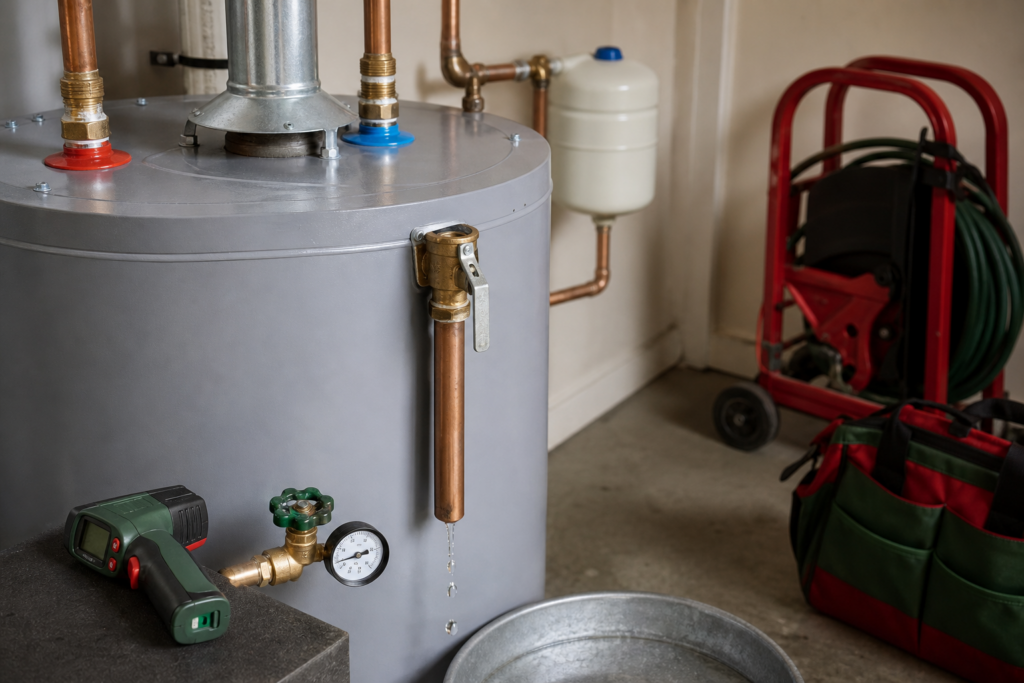
A water-heater relief valve may drip during a heating cycle because water expands as its temperature rises. If that expansion cannot move back into the supply, system pressure can increase until the temperature-and-pressure relief valve releases a small amount of water. High incoming pressure, overheating, a control problem, debris at the valve seat, or a worn valve can produce a similar symptom.
The timing is useful evidence, but it is not a diagnosis. Never cap, plug, clamp, reduce, or install a shutoff on the relief valve or its discharge tube. That path is a safety device for excessive temperature or pressure.
Treat Continuous or Very Hot Discharge as Urgent
Stop using the heater and keep people away if the tube releases a steady stream, sprays, produces steam, discharges unusually hot water, or continues flowing after the heating cycle ends. Do not touch the water, valve, lever, or discharge tube. They can cause burns.
If water reaches electrical equipment, wiring, outlets, or the heater’s electrical connections, do not enter the wet area or operate nearby switches. Isolate the area and follow appropriate electrical and emergency guidance for the condition.
An unusually hot faucet temperature, boiling sound, steam, repeated control reset, scorching, soot, gas odor, or carbon-monoxide alarm is not a routine drip. Stop using the heater and follow the utility, alarm manufacturer, or emergency-service instructions that apply. Leave the building for gas odor and make contact from a safe location.
Do not try to stop a continuous discharge by closing a valve on the relief path. The cause of the temperature or pressure rise must be identified while the safety outlet remains unobstructed.
The Relief Valve Protects the Tank
The temperature-and-pressure relief valve, often called a T&P valve, opens when its rated safety threshold is reached. It connects directly to the tank and uses a discharge tube to direct released water toward an appropriate termination point.
The valve is not an ordinary leak-control fitting. Its lever must remain operable, and the outlet must not be capped, threaded shut, reduced, crimped, or connected to a closed container. A discharge tube that slopes upward, terminates where damage cannot be seen, or uses an undersized or obstructed path needs professional review.
Do not lift the test lever just to see whether the drip changes. On an older or mineral-affected valve, manual operation can disturb the seat and create a larger leak. Follow the exact heater and valve manufacturer instructions and leave condition testing to a qualified person when the history is unknown.
A Few Drops During Heating Can Point to Thermal Expansion
Water takes up slightly more volume as it heats. In an open plumbing system, some expanded water may move back toward the supply. In a closed system, a check valve, backflow device, pressure-reducing valve, or other condition can prevent that movement.
The expanding volume then raises pressure within the home’s piping. The relief valve may release a few drops near the end of a heating cycle and stop after pressure falls. That pattern makes thermal expansion one possibility, but the same timing can occur when baseline pressure is already high or the valve has weakened.
An expansion tank may be part of the pressure-control design, but its presence does not prove it works. Its size, connection, air charge, waterlogging condition, and relationship to normal supply pressure all matter. Do not press a tank valve, add air, or replace the tank based only on a dripping discharge tube.
High Supply Pressure Can Reduce the Margin
A home’s water pressure can vary by time of day and demand. If baseline pressure is already high, normal heating expansion has less room before the relief path reacts. A pressure-reducing valve may also be misadjusted, worn, or responding inconsistently.
One pressure reading is not always enough. A plumber may compare static pressure, pressure during heater operation, and the peak reached as the tank recovers. The measurement point and gauge condition matter.
Do not adjust a pressure regulator or install a different relief valve rating to stop the drip. Changing a safety rating or lowering pressure without understanding the complete system can hide the evidence without correcting the cause.
Bigg Tree Rooter & Plumbing’s water-heater repair service in San Jose can evaluate the valve, tank, controls, pressure pattern, and visible discharge arrangement as one system.
Overheating or Control Trouble Must Be Ruled Out
A thermostat, gas control, heating element, relay, sensor, or wiring problem can allow the tank temperature to rise beyond the intended setting. The T&P valve may then be responding correctly to an unsafe condition.
Do not assume the displayed setting equals the actual water temperature. Control labels vary, and stored water can be hotter than the temperature measured after it travels through piping and a mixing valve.
Record whether faucets suddenly feel hotter, the heater runs longer than usual, an electric unit cycles unpredictably, or a burner continues when expected to stop. Do not remove access covers, probe wiring, adjust gas controls, bypass a limit, or turn a thermostat up or down as a test.
The Valve Seat Can Wear or Trap Debris
Mineral particles or debris can prevent a relief valve from resealing completely after it opens. Springs, seals, and internal surfaces can also deteriorate. A valve may then drip at pressures and temperatures below its original opening point.
Replacing the valve can be appropriate when measurements show that system pressure and water temperature remain controlled and the valve itself does not hold. Replacing it without those measurements can lead to another drip if thermal expansion, high pressure, or overheating remains.
The existing San Jose leak-detection guidance can help distinguish supply-side water movement from other visible moisture. A relief-tube pattern should still be evaluated as a pressure and temperature safety condition rather than treated as a generic pipe leak.
The Discharge Tube Needs Its Own Inspection
Water may appear at the lower end even when the valve body looks dry, which is exactly what a proper discharge path is intended to reveal. Water around the tank can also come from a drain valve, supply connection, tank seam, condensate source, or nearby plumbing.
Trace only what can be seen from a safe, dry position. Do not disconnect the tube, insert a plug, add a threaded cap, route it into a sealed container, or place your hand beneath the outlet. A plumber can confirm that the material, size, route, termination, and visible air gap meet the installation requirements that apply.
If the tube already terminates over a drain pan, do not assume the pan can contain a continuous release. Keep stored items away from the outlet and do not block the path with a bucket, hose, rag, or tool.
Safe Details to Record
Useful observations can narrow the diagnosis without touching the heater:
- Note whether dripping begins while the burner or elements operate, near the end of recovery, or after all heating stops.
- Record whether the discharge is a few drops, an intermittent trickle, or continuous flow.
- Note whether hot-water demand occurred just before the cycle.
- Record any recent pressure-regulator, backflow, meter, water-main, heater, or expansion-control work.
- Note whether faucet water seems hotter than usual without measuring at the relief outlet.
- Photograph the valve and full discharge route from a safe distance.
- Record visible gauge readings only if an existing installed gauge can be viewed without adjustment.
- Note water around other connections, the drain valve, or the tank base.
- Keep the heater model, serial information, and service history available.
Do not repeat a heating cycle solely to reproduce a leak. A clear timing observation from normal use is enough to begin the inspection.
What a Professional Diagnosis May Include
A cause-led evaluation may include:
- Confirming the heater model, fuel or power type, capacity, and control design.
- Inspecting the T&P valve rating, installation, lever, and discharge path.
- Measuring static, operating, and peak water pressure.
- Measuring delivered and tank-related temperature with appropriate methods.
- Observing whether the drip follows pressure rise, temperature rise, or both.
- Checking the function and setting of a pressure-reducing valve when present.
- Evaluating expansion control and an expansion tank when present.
- Checking thermostat, element, burner, gas-control, sensor, and limit behavior as applicable.
- Looking for mineral debris, corrosion, tank leakage, or a valve that does not reseal.
- Rechecking a complete heating cycle after the verified correction.
Bigg Tree Rooter & Plumbing also provides residential plumbing service when the pressure condition involves supply piping, shutoffs, or related home plumbing rather than the heater alone.
Repair and Replacement Depend on the Verified Cause
A valve replacement may solve the problem when the valve is defective and pressure and temperature remain within the correct operating range. Expansion control, regulator repair, or another pressure correction may be needed when the valve is responding to system pressure. A thermostat, control, element, burner, or wiring repair may be considered when overheating is verified.
Heater replacement may enter the discussion when the tank leaks, safety components cannot be restored reliably, damage is extensive, or suitable parts are unavailable. Age alone and a dripping relief tube alone do not decide the outcome.
Ask which pressure, temperature, and operating observations support the recommendation. The repair should address the cause that made the valve discharge, not simply silence the visible symptom.
Request Water-Heater Service in San Jose
Leave the relief valve and discharge tube unobstructed, keep people away from hot water, and stop using the heater for continuous discharge, steam, or unusually hot water. Contact Bigg Tree Rooter & Plumbing to arrange a measured San Jose water-heater evaluation of the valve, pressure, temperature, expansion control, and heater operation.