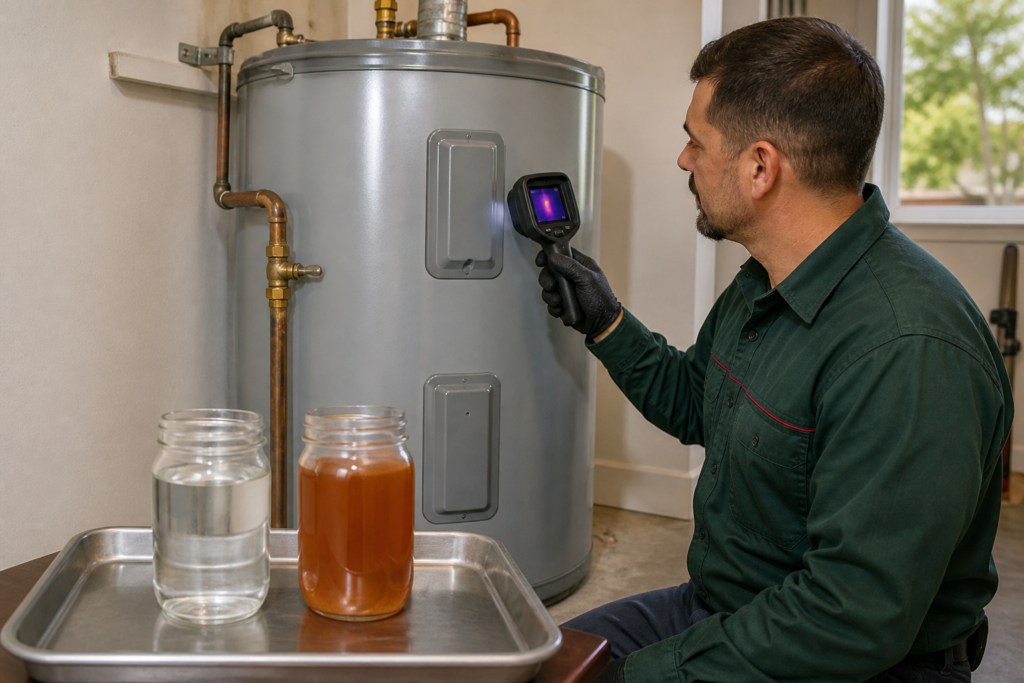
Rusty, orange, or brown water that appears only when you use the hot side points the inspection toward the water heater or the hot-water piping. Sediment disturbed inside a tank, internal corrosion, the condition of the heater’s corrosion-protection system, or material released from hot-side piping can produce similar-looking water. Color alone cannot identify which condition is present.
Do not drink, cook with, or repeatedly flush visibly discolored hot water while the source is unknown. Avoid touching unusually hot water, and do not drain the tank, remove fittings, or open heater panels to investigate. The most useful first evidence is whether the cold water stays clear and whether the color appears at one hot fixture or several.
Compare Hot and Cold Without Repeated Testing
Use observations from normal water use rather than running gallons of water to reproduce the problem. Note whether the cold side was clear when the hot side appeared rusty or brown. If a small sample was already collected safely from a normal faucet draw, a clear container can make the color difference easier to describe. Do not collect water from the heater drain valve or relief-valve discharge.
The comparison changes the likely inspection path:
- Discoloration at several hot taps while cold water remains clear puts the heater and shared hot-water piping higher on the list.
- Discoloration at only one fixture can involve that fixture, its connector, or a nearby hot branch rather than the entire heater.
- Discoloration from both hot and cold taps can point toward the incoming supply, older distribution piping, recent utility work, filtration equipment, or another whole-home condition.
- Color that appears once after plumbing work and clears during ordinary use may involve disturbed material, but persistence or recurrence still deserves investigation.
These patterns narrow the system involved; they do not prove whether sediment, corrosion, a component, or piping is responsible.
Stop Using the Water if Other Warning Signs Appear
Keep away from the heater and stop using it if discolored water occurs with a tank leak, water spreading around the base, spraying, steam, an unusually hot faucet temperature, scorching, soot, a gas odor, or water near electrical equipment. Do not touch wet electrical equipment or operate nearby switches. Leave the area for a gas odor and follow the utility or emergency guidance that applies from a safe location.
Rust on the outside of a tank, damp insulation, corrosion at connections, or water at the base can be separate evidence from color at a faucet. Bigg Tree Rooter & Plumbing’s San Jose leak-detection guidance can help frame visible moisture, but an actively leaking heater should be evaluated as a water-heater condition rather than treated as a color-only concern.
Tank Sediment Is One Possibility
Minerals and small particles can settle in the bottom of a tank water heater over time. A change in flow, recent service, movement of the heater, or other disturbance can mix some material back into the stored water. That can create temporary cloudiness or color, depending on the material and the condition of the tank.
Sediment is not the only explanation for brown hot water. The appearance does not show how much material is present, whether it came from the tank, or whether flushing would be appropriate. An older or weakened tank can be damaged by improvised draining or aggressive homeowner work, and hot water at a drain valve can cause burns.
Do not connect a hose, open the drain valve, cycle a shutoff, or operate the relief-valve lever as a test. A plumber can review the heater age, maintenance history, tank condition, water quality context, and manufacturer requirements before deciding whether any controlled service is appropriate.
Internal Corrosion Can Release Rust-Colored Material
A steel storage tank relies on its lining and corrosion-protection system to limit contact between water and metal. If internal protection has deteriorated or the tank has begun corroding, rust-colored material can enter the hot water. Connections, nipples, or older hot-water piping can also corrode and release material.
An anode component is designed to help protect many tank-style heaters, but its condition cannot be inferred from water color alone. Heater design, water chemistry, age, prior maintenance, and the condition of the tank all matter. Some discoloration blamed on an anode can come from another part of the system, while a depleted or improperly matched component can leave a tank with less corrosion protection.
Do not remove an anode component or any top connection. Those parts can be difficult to access, the tank can contain scalding water, and removal can damage fittings or create a leak. A professional inspection can determine which checks are appropriate for the specific model and condition.
One Fixture Can Point to a Local Hot-Side Condition
If only one sink, tub, or shower shows color while other hot fixtures remain clear, the water heater may not be the only place to inspect. A flexible connector, stop valve, faucet body, local branch, or material trapped near that fixture can affect one outlet.
Note the exact fixture, whether the color appears immediately or after the water warms, and whether recent faucet or valve work occurred there. Do not dismantle the faucet, remove a connector, or open the wall. A single-fixture pattern helps a plumber avoid assuming that the entire tank is failing when the evidence points to a smaller part of the hot-water path.
If several hot fixtures show the same color, record which ones and when. That shared pattern makes a common hot-water source or distribution path more relevant, but it still does not prove the tank must be replaced.
Both Hot and Cold Discoloration Needs a Different Path
When both sides are discolored, the incoming supply or whole-home piping deserves attention. Recent water-main work, changes in source water, older galvanized lines, disturbed deposits, or treatment equipment can create color before water reaches the heater.
Older galvanized piping can release rust-colored material and may also reduce flow as corrosion builds internally. That is different from a condition limited to water stored or carried on the hot side. The hot-versus-cold comparison helps keep those two service decisions separate.
A whole-home water-filtration system may address specific particles, taste, odor, or water-quality goals after the concern is identified. Filtration should not be used to mask a corroding tank or piping failure, and generic discoloration does not establish which filter or treatment method is appropriate.
Recent Plumbing Work Can Disturb Material
Water shutoffs, valve replacement, heater service, changes in pressure, or work on nearby piping can loosen material that had settled inside a line or tank. The timing is worth recording. Note what work occurred, which part of the plumbing was affected, and whether the color began immediately afterward.
A one-time event and a recurring hot-only pattern are different evidence. If color returns after it seemed to clear, appears at several hot fixtures, or is accompanied by particles, unusual noise, reduced hot-water performance, or visible corrosion, arrange an inspection rather than repeatedly running water in hopes that it disappears.
Do not assume a contractor caused damage merely because discoloration followed service. The sequence helps define what should be checked; it does not identify responsibility or the failed part.
Safe Details to Record
Useful observations require no access to the heater’s internal parts:
- Whether cold water remained clear during normal use.
- Whether one hot fixture or several showed the same color.
- Whether the water looked yellow, orange, reddish, brown, cloudy, or particle-filled.
- Whether the color appeared immediately or only after the water warmed.
- Whether it happened once, persisted, or returned on another normal use.
- The heater’s approximate age and any known service history.
- Recent water shutoffs, heater work, valve work, plumbing repairs, or utility notices.
- New noises, reduced hot-water performance, leaks, moisture, or corrosion visible from a safe, dry position.
- Whether a filtration or softening system was recently serviced, bypassed, or changed.
Photograph a safely collected faucet sample and the heater exterior only if you can do so without touching hot water, moving equipment, or entering a wet area. Do not open panels, remove insulation, adjust controls, lift a relief-valve lever, loosen a fitting, or repeat long faucet draws.
What a Water-Heater Inspection May Include
A condition-led inspection may compare the fixture pattern with the heater and hot-water distribution system. Depending on the equipment and symptoms, a plumber may:
- Confirm the heater type, model, age, capacity, and service history.
- Inspect the tank exterior, hot and cold connections, valves, and accessible hot-side piping.
- Compare hot- and cold-water samples using appropriate methods.
- Look for evidence of disturbed sediment, internal corrosion, or deteriorating connections.
- Evaluate the corrosion-protection system when the model and tank condition make that check appropriate.
- Check whether one fixture, one branch, or several hot outlets are affected.
- Review recent plumbing or utility work and any water-treatment equipment.
- Check for leaks, unsafe temperature behavior, control problems, or other symptoms that change the priority.
- Explain whether targeted service, a piping repair, monitoring, or heater replacement is supported by the findings.
The correct next step depends on the source and condition, not on color alone. Bigg Tree Rooter & Plumbing’s water-heater repair service in San Jose can evaluate the heater and hot-water path without assuming that every rusty sample requires a new tank.
Repair or Replacement Depends on the Finding
Some causes may be limited to a connector, valve, local branch, or serviceable heater component. Other findings—such as a leaking or internally failing tank—can make replacement the safer practical decision. Heater age matters, but age alone does not decide the outcome.
A useful recommendation should identify where the material is coming from, whether the tank remains sound, whether hot-water safety is affected, and whether a repair would address the actual condition. Replacing a filter or repeatedly flushing faucets without that diagnosis can delay the needed work.
Request San Jose Water-Heater Diagnosis
If rusty or brown water keeps appearing only from hot taps, stop using it for drinking and cooking, preserve the hot-versus-cold and fixture pattern, and avoid opening or draining the heater. Mention any recent plumbing work, unusual temperature, noise, particles, or visible moisture when you call.
Contact Bigg Tree Rooter & Plumbing for a San Jose water-heater inspection. The goal is to identify whether the evidence comes from the tank, a hot-water connection or branch, or a different whole-home condition before recommending repair or replacement.