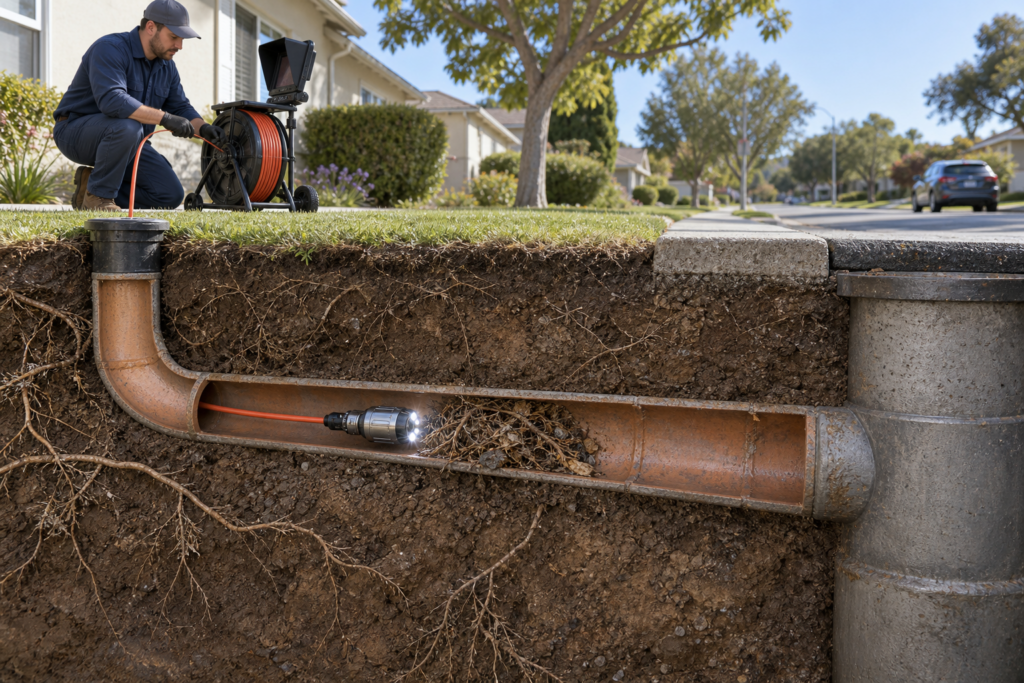
A sewer camera can stop before reaching the street connection when something blocks its path, hides the view, or makes the line too difficult to navigate safely. Dense buildup, roots, standing water, a shifted joint, a damaged section, limited access, or a tight turn are all possible reasons. The stopping point alone does not prove which one is present.
What the camera did reach still matters. The visible section can show where the inspection began, how far the camera traveled, what the pipe looked like along the way, and what appeared just before the camera stopped. Those details help determine whether the next reasonable step is clearing the line, trying another access point, or gathering more information before discussing repair.
What Can Keep the Camera From Moving Farther?
A sewer camera is built to travel through a drain or sewer line, but it cannot pass every condition. The cable has to move through the actual path of the pipe. If the route narrows, fills, shifts, or turns too sharply, forcing the camera forward can risk lodging or damaging the equipment without producing a useful view.
A dense blockage or root mass
Grease, waste, scale, debris, or other material can form a restriction that leaves too little room for the camera head. Roots may also create a tangled barrier inside the line. Sometimes the camera captures a clear image of material at the stopping point. In other cases, the lens reaches murky water or debris before the nature of the obstruction can be seen clearly.
An apparent blockage still needs careful interpretation. The camera may be touching the beginning of a larger mass, or it may be stopping at a different pipe condition hidden behind loose material. A professional may consider an appropriate rooter service in San Jose when the available evidence supports clearing, but no single method is right for every pipe or every obstruction.
Standing water and poor visibility
Standing water can cover the lens or prevent a clear view of the bottom and sides of the pipe. Water may be present because flow is restricted farther down the line, but the camera image by itself may not reveal exactly where or why. Sediment stirred up during the inspection can make visibility even worse.
Poor visibility and limited travel are related but different findings. A camera may continue moving without producing a clear picture, or it may stop while submerged. The inspection record should distinguish between the farthest physical reach and the last location where the pipe could be seen well enough to evaluate.
An offset joint, deformation, or collapsed area
Sewer lines are assembled from sections or formed as a continuous run, depending on the material and installation. If one section shifts out of alignment, the resulting edge may catch the camera head. A deformed or collapsed area may also reduce the opening.
These are possibilities, not conclusions based only on resistance. The same stopping behavior could come from accumulated debris or the angle of approach. A visible lip, broken edge, change in pipe shape, or sudden loss of the opening provides more useful evidence, but even then the location and extent of the condition should be documented before a repair choice is made.
Restricted access or a turn the camera cannot pass
The access point affects the route the camera must take. A cleanout’s location, size, and direction can limit how easily the cable enters the main line. Multiple turns or a particularly tight bend may prevent the camera head from advancing even when the pipe beyond that point is open.
That means a camera stopping before the street connection does not always mean something is wrong at the stopping point. The practical limit may come from the available approach. When another suitable access point exists, a plumber may assess whether it can provide a safer or more direct view. Homeowners should not open caps or attempt to create access themselves.
Why Stopping Short Does Not Confirm the Cause
The camera’s stopping point is one piece of evidence. It confirms that the first inspection did not travel beyond that location under those conditions. It does not automatically confirm roots, a collapsed line, an offset joint, or any other specific cause.
Good diagnostic notes separate direct observations from possibilities. A note such as “the camera traveled approximately this distance, standing water began here, and the last clear image showed heavy buildup” is more useful than labeling the line as collapsed without a visible basis. The first description preserves what was actually observed and makes the unknown section clear.
This distinction matters because different conditions may call for very different next steps. A removable obstruction, a difficult access angle, and a structurally damaged pipe should not be treated as the same problem. A focused sewer camera inspection should support the decision process, not turn an incomplete view into a guess.
What Should Be Recorded From the Reachable Section?
Before any cleaning or repair decision, ask what the inspection documented. Useful details may include:
- The access point used for the camera
- The approximate distance reached
- The last point where the image was clear
- Visible buildup, roots, debris, cracks, joints, or changes in pipe shape
- Whether the lens entered standing water
- How the camera behaved when it stopped, such as meeting steady resistance or failing to pass a turn
- Whether the location could be estimated relative to the building, yard, sidewalk, or street connection
- Any section that could not be viewed
Video, still images, and written notes can help preserve the condition of the reachable section. They also help a homeowner understand which statements are observations and which remain possible explanations.
If a prior company performed the inspection, tell the next plumber whether you received footage, a distance reading, or a marked location. Even partial records may prevent unnecessary repetition and help frame the next diagnostic attempt.
What May Happen Before Another Camera Attempt?
The appropriate next step depends on what was observed, the pipe’s known condition, and the available access. If the evidence suggests a removable obstruction and the pipe can safely receive cleaning, a plumber may discuss a clearing method. If the access route is the limiting factor, another suitable entry point may be considered. A second camera pass may then show whether the route has opened and reveal the section that was previously hidden.
Hydro jetting in San Jose is one possible cleaning service, but it is not automatically appropriate whenever a camera stops. The pipe condition and suspected obstruction matter. Rooter equipment is another possible approach for certain stoppages, but it also does not guarantee that the camera will reach the street connection afterward.
The safest sequence is based on evidence, not a preferred tool. First preserve what the camera showed. Then assess whether cleaning or alternate access is reasonable. Finally, inspect again when conditions allow. If the path remains impassable, additional location or condition information may be needed before deciding what work makes sense.
Do Not Choose a Sewer Repair From an Incomplete View Alone
An incomplete camera run should not be treated as automatic proof that the sewer needs lining, bursting, excavation, or replacement. Those are different kinds of work with different suitability requirements. The unseen section may contain the actual cause, while the stopping point may only show where the first inspection lost access.
Before discussing sewer repair in San Jose, the diagnostic record should be as specific as the conditions allow. Important questions include where the suspected problem is located, how much of the pipe was viewed, whether damage was actually visible, and whether clearing changed the result. A repair recommendation should rest on the pipe condition and location that can be supported, not on the simple fact that a camera stopped.
This evidence-first approach also reduces uncertainty for the homeowner. It creates a clearer connection between the observed problem and the proposed next step. If part of the line remains unseen, that limitation should remain explicit.
What Can You Safely Observe at Home?
You can provide useful information without handling the sewer line. Note which drains or fixtures were affected before the inspection, when the symptoms started, and whether the problem has happened before. Write down any gurgling, sewer odors, slow drainage, or visible backup you already noticed. Also share what earlier cleaning was attempted, which access point was used, and what the person operating the camera said was visible before it stopped.
Do not run more water to test a backed-up system. Do not remove cleanout caps, insert tools, pour chemicals into the drain, or touch wastewater. If sewage is backing up, stop water use in the home as much as practical and keep people and pets away from the affected area until the condition can be assessed.
When arranging service, have any footage, photos, invoices, or written findings available. If no records were provided, a simple account of the stopping point and earlier work can still help. Useful details include whether cleaning happened before or after the camera attempt, whether a distance was mentioned, and whether the camera ever regained a clear view.
Request a Sewer Camera and Diagnostic Appointment in San Jose
If a sewer camera stopped before the street connection, Bigg Tree Rooter & Plumbing can evaluate the available information and the next diagnostic step. Be ready to describe where the camera entered, approximately where it stopped, what was visible before that point, and what cleaning or access attempts have already occurred.
Call (408) 373-8484 to request a sewer-camera and diagnostic appointment in San Jose. You can also contact Bigg Tree Rooter & Plumbing with the details you have from the first inspection.