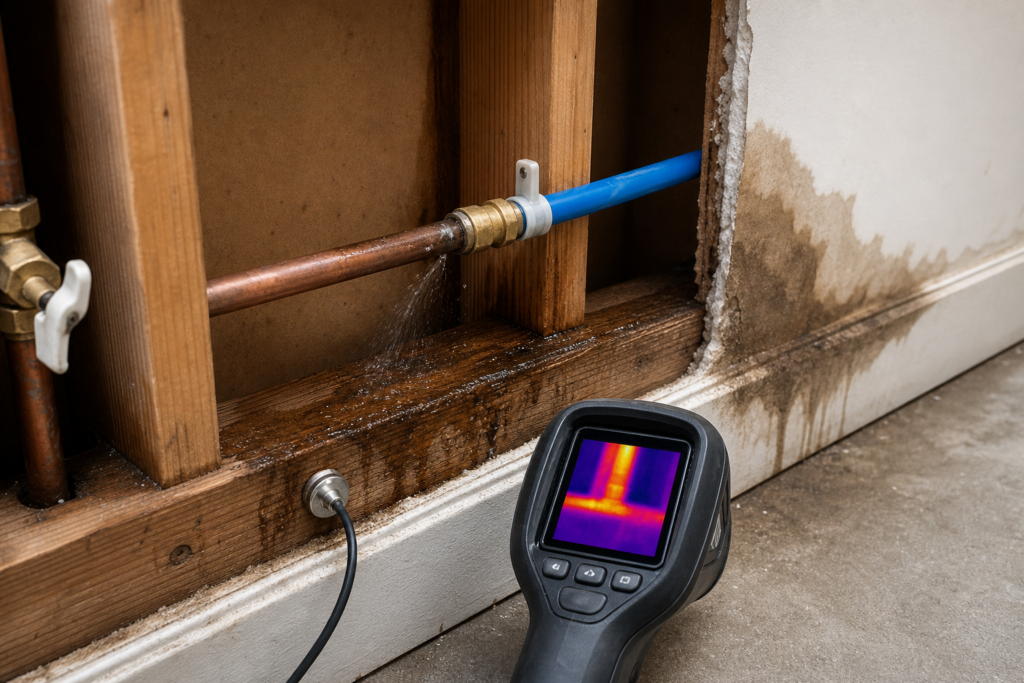
Water damage can appear several feet away from a hidden plumbing leak because water follows the easiest available path before it reaches a visible surface. It may run along a pipe, stud, joist, framing plate, drywall paper, cabinet panel, or flooring layer. The stain you see can mark where the water finally escaped, not where the pipe actually failed.
That distance is why cutting directly behind a stain can miss the leak and create unnecessary damage. A careful inspection works backward from the wet area, follows the moisture pattern, and tests which plumbing use makes the symptom change. The goal is to narrow the source before opening a wall, ceiling, cabinet, or floor.
Water Does Not Always Fall Straight Down
Gravity pulls water downward, but the surfaces inside a home redirect it. A small supply-line leak can land on the top of a horizontal framing member and travel sideways. Water can follow the underside of a pipe before dripping at a fitting, strap, or low point. It can also move through the seam between building materials and appear where that hidden path ends.
This can make the visible pattern confusing. A stain below an upstairs bathroom may be offset from the toilet, tub, shower, or supply line involved. Damp flooring near a doorway may begin inside a wall or under a cabinet. A swollen baseboard may be the lowest place moisture reached even though the plumbing failure is higher or farther away.
The amount of water matters too. A large active leak may reveal itself quickly near the source. A pinhole leak can wet the same concealed materials slowly, allowing moisture to spread through a wider area before the paint, drywall, wood, or flooring shows a change.
Framing and Finish Materials Can Carry Moisture
Wood, drywall, insulation, carpet padding, and some flooring underlayments can absorb and redistribute moisture. Drywall paper may darken or soften beyond the exact wet point. A wood stud or sill plate can stay damp along its grain. Insulation can hold water against surfaces and make the affected area look broader than the opening in the pipe.
Small gaps also influence the path. Water can move between a pipe and a framing penetration, along the edge of a subfloor, or beneath a finished floor. When it reaches a joint, fastener, light opening, or baseboard edge, it may finally become visible.
Repeated wetting can expand the damage pattern. A leak that operates only when a fixture is used may add a little water at a time. The first visible stain may dry between uses while concealed material remains damp. After enough cycles, the homeowner may notice peeling paint, a musty odor, softened drywall, warped trim, or flooring that feels different underfoot.
The Visible Stain Is a Clue, Not a Diagnosis
The shape and location of a stain help define the inspection area, but they do not prove which pipe or fixture failed. Similar damage can come from a pressurized water line, a drain connection, a toilet seal, a shower enclosure, an appliance supply, a water heater, condensation, exterior water, or another source.
Timing often provides a stronger clue than appearance alone. A pressurized supply leak may continue when no fixture is in use. A drain-side leak may become active only while a sink, tub, shower, toilet, or appliance drains. Moisture connected to a particular fixture may appear shortly after that fixture runs, even if the stain is not directly beneath it.
Color and odor can also help a professional decide what to test, but they should not be used as a stand-alone diagnosis. Hidden materials, dust, rust, finishes, and the length of time an area has stayed wet can change what the water looks or smells like.
Safe Observations Can Help Narrow the Pattern
Homeowners can record useful information without opening walls or touching plumbing. Note when the moisture first appeared, whether the stain grows, and what water use happened beforehand. Photograph the affected area from the same angle with the date and time so changes are easier to compare.
Useful observations include:
- Whether the damp area changes after a shower, toilet flush, dishwasher cycle, laundry load, or sink use.
- Whether running-water sounds continue when known fixtures are off.
- Whether the water meter shows movement when no intentional water use is occurring, if the meter can be viewed safely.
- Whether a warm floor area, pressure change, recurring cabinet moisture, or higher water bill appeared around the same time.
- Whether the stain grows during rain or when no plumbing has been used, which may point the inspection toward another source.
Do not remove drywall, drill exploratory holes, pull up flooring, or disturb a pressurized line just to gather more evidence. Those actions can enlarge the damage, strike hidden utilities, or turn a small leak into an active release.
How a Plumber Works Backward From the Damage
A plumber starts by confirming what is wet and mapping how far the moisture extends. The inspection considers the rooms above, below, and beside the visible damage; nearby fixtures and appliances; accessible valves and piping; and the times when the symptom changes.
The next step is usually to separate possible systems. Fixture-use testing can show whether moisture appears when a particular supply or drain operates. Meter behavior and controlled isolation may help determine whether a pressurized water line is losing water. Accessible connections can be inspected for active beads, staining, corrosion, or water tracks.
Depending on the conditions, a plumber may use a moisture meter to compare material readings, thermal imaging to identify temperature patterns associated with wet areas, or acoustic listening equipment to narrow the sound of water escaping from a pressurized line. These tools provide evidence; none guarantees that a leak will be identified by itself. Insulation, pipe depth, material type, water temperature, background noise, and the leak’s size can all affect the result.
Bay Emergency Plumber’s leak detection service in San Jose is intended for symptoms such as hidden wall or ceiling moisture, slab-leak concerns, running-water sounds, meter movement, damp cabinets, and unexplained water bills. The useful outcome is a repair plan tied to the likely source rather than a guess based only on the stain.
Why Targeted Access Matters
Some leaks cannot be repaired without opening a finished surface. The important distinction is whether the opening follows evidence or begins as exploratory demolition. Moisture mapping, system testing, and inspection of accessible plumbing can reduce the area that must be opened and help place access where the suspected pipe or connection can actually be reached.
Targeted access also helps reveal the full repair conditions. The first opening may show that water traveled along framing from another bay or from above. If that happens, the inspection should follow the physical water track rather than forcing a repair at the first damp spot.
After access, the plumber can confirm the pipe material, connection type, extent of the failure, and whether surrounding piping shows a broader concern. One failed fitting may need a localized repair. Repeated leaks, widespread deterioration, pressure problems, or damage across multiple areas may justify a wider evaluation. That decision should come from what is found at the property.
When Hidden-Leak Symptoms Need Urgent Action
Treat the situation as urgent when water is actively spreading, a ceiling is sagging or bulging, standing water is near electrical equipment, a supply line has burst, or you cannot stop a fixture from overflowing. Keep people away from an unsafe wet area. If you can safely reach the correct fixture shutoff or main water shutoff, turning it off may limit additional damage.
Do not touch electrical equipment, switches, outlets, or appliances in or near standing water. Do not stand beneath a swollen ceiling. If the area is unsafe or you are uncertain which valve controls the leak, wait for qualified help.
San Jose homeowners dealing with active water can review the emergency plumbing service for urgent next-step information. A stable old stain and an actively growing wet area require different response priorities, even though both still need their source identified.
What Happens After the Source Is Found
Locating the likely source is only the first part of solving the problem. The plumber should explain what failed, how the finding connects to the visible damage, what access is needed, and whether the repair can be isolated to one component or pipe section.
Ask what will be repaired, how the water will be controlled, and how the plumbing will be tested afterward. Also clarify whether drying, drywall, paint, flooring, cabinet, or other finish restoration is included. Plumbing repair stops the water source; it does not automatically dry or restore every material that became wet.
Wet porous material may need prompt evaluation and drying even after the leak is stopped. The right response depends on the amount of water, how long the area was wet, the materials involved, and whether contaminated water is possible. Do not conceal damp material behind a new finish simply because the surface stain looks smaller.
Avoid Common Guessing Mistakes
The most common mistake is assuming the center of the stain sits directly below the leak. Another is treating every ceiling mark as plumbing or every damp floor as a slab leak. Starting with those conclusions can lead to the wrong opening or repair.
Homeowners should also avoid repeatedly sealing the visible surface before the source is confirmed. Paint, caulk, patching compound, or a temporary floor covering may hide a symptom without stopping the water. If the stain returns, the concealed materials may have continued getting wet between repairs.
A professional assessment should connect several pieces of evidence: the moisture path, plumbing layout, timing, meter or isolation results, accessible inspection findings, and any diagnostic-tool readings. Agreement among those clues makes a targeted repair more defensible than any one clue on its own.
Get the Hidden Leak Traced Before Opening More of the Home
If a stain, damp floor, swollen baseboard, or musty area keeps returning, do not assume the visible spot identifies the pipe failure. Record when the symptom changes, avoid disturbing concealed plumbing, and address active water immediately.
To arrange a property-specific inspection, contact Bigg Tree Rooter & Plumbing. A leak-detection visit can help trace the moisture pattern, separate likely plumbing sources, and plan the smallest practical access based on evidence found in your San Jose home.